-
- Reseller
-
Products
Tailored Product Demo for Your Exact Needs
Explore how our solution delivers efficiency, control, and scalability.
Request a Demo
-
Solutions
Tailored Product Demo for Your Exact Needs
Explore how our solution delivers efficiency, control, and scalability.
Request a Demo
- Dashboard
- Features
- Pricing
Insert signatures in different languages
Sigsync Microsoft 365 Email Signature Software lets organizations manage email signatures in different languages for Microsoft 365 (Office 365). You can automatically assign language-specific signatures using recipient or sender rules, apply a signature when defined keywords are found, or let users choose a signature while composing an email in Outlook or Outlook on the web (OWA).
This guide covers five practical methods. Create the required language-specific signature templates, such as English, German, and Spanish, before configuring the appropriate rules. Signature rules use the conditions you specify; they do not automatically detect or translate the language of every message.
Methods to add signatures in different languages
- Method 1. Automatically add language-specific signatures based on email recipients
- Method 2. Automatically add language-specific signatures for specific senders, groups, or Country attribute
- Method 3. Add signatures in different languages based on keywords
- Method 4. Select a language signature while composing in Outlook or OWA
- Method 5. Add signatures in different languages using Sigsync custom attributes
Method 1. Automatically add signatures in different languages based on email recipients
Create a language-specific signature rule based on recipients. For example, you can apply a German signature to messages addressed to selected email addresses or to recipients whose email domains match a configured value. Recipient-based rules are supported in Server Mode, Centralized (Combo) Mode, and Client Mode. Configure recipient conditions using the options available for your selected mode. See recipient-based signature rules.
- Under 'Signature Rules', navigate to the 'Recipients' tab where you can add email addresses under 'Add Signature - based on Recipients' section.

- Now, check the 'Email addresses or Domain' option as shown in the screenshot below and click the 'Edit' button.

- Enter the email address or domain name so that signature will be appended to that recipient. Click on the 'Save' button to apply the changes.
For instance: If you want to add email signatures to only Argentina recipients, enter the domain name as .ar (for example, .ar for Argentina, .sa for Saudi Arabia, .de for Germany) as shown in the screenshot. Here, either provide a domain name (for example, .ar) or specify their individual email addresses (for example, user@example.de)

Method 2. Automatically add signatures in different languages to emails sent by specific users
Sigsync can apply a language-specific signature based on Selected Senders, Senders from Group, or an Azure AD Filter. For example, users based in Germany can receive the German signature automatically when their sender profile has Country = Germany. This selects the signature from a configured rule; it does not translate the email. Recipient and sender targeting are supported in Server, Centralized (Combo), and Client Modes, with rule settings depending on the selected mode.
First, create your German, Spanish, and English signature templates. Under Signature Rules, create a separate rule for each language (for example, German_Country) and assign the corresponding language template under Assign Signature Template. Under Senders, use one of the following sender conditions.
- Selected Senders: Open the Senders section, select Selected Senders under Add Signature - based on Senders, and click Edit. Choose the specific users who should receive the assigned language signature, then save the selection. For example, select the members of a German-speaking customer support team.

- Senders from Group: To apply a language-specific signature to all senders in a particular Microsoft 365 group, select Senders from Group and click Edit. Select a group such as the German sales team and save. Use a separate rule for another language group.

- Azure AD Filters: For a sender attribute-based rule, select Azure AD Filters in Add Signature - based on Senders and click Edit. This opens the directory-field filter settings.

- Configure Country = Germany: In the Azure Active Directory filter window, set User AD field: Country, Operator: Equals and Value: Germany, then click Add to list. Keep All of the conditions above are met selected for this example and click Save. Save the main signature rule as well. This works only when the corresponding country field is populated correctly for the sender.
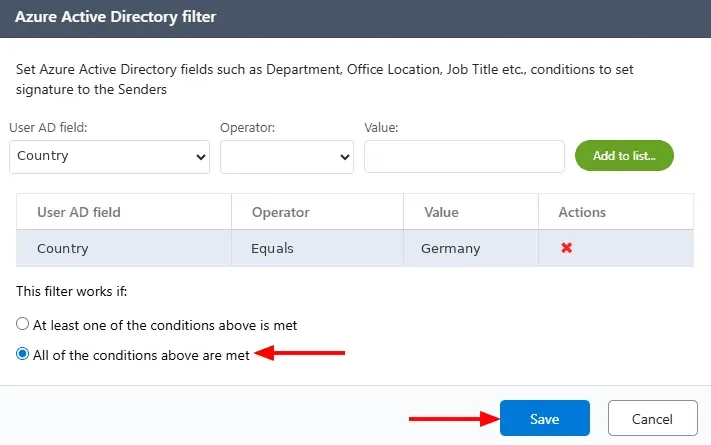
For a more detailed overview, see how to apply signatures based on senders. If several language rules may match the same message, configure rule priority as described below.
Method 3. Add signatures in different languages based on keywords
Available in Centralized (Combo) Mode and Server Mode. Keyword rules do not work in standalone Client Mode. Configure a keyword or phrase in a signature rule and assign the matching language template. When the configured text is found in the email subject or body, Sigsync processes that rule on the server. For example, you can configure a Spanish-language signature when the phrase empresa de prueba is present in the specified location.
Click here to know about Office 365 email signature based on Keywords
- Click the 'Add Keywords' button under 'Add signature - based on keywords' as shown.

- Now, Add a phrase of your choice and set 'Search in' option
For instance: Add a Spanish text (empresa de prueba) as a phrase.

- Save the rule changes
- Now, while composing email, include the above phrase in the email subject or body as per your rules settings.
Method 4. Select a language-specific signature while composing an email in Outlook or OWA
In Centralized (Combo) Mode and Client Mode, senders can use the Sigsync Outlook Add-in to choose a language-specific email signature while composing messages in Outlook or Outlook on the web (OWA). For example, users can select an English, German, or Spanish signature from the signatures assigned to them. This selection is not available through the Add-in in standalone Server Mode.
Before users can select signatures in Outlook, complete the setup required for the chosen mode:
- Centralized (Combo) Mode: Configure the Exchange Online connectors for the relevant senders in the Sigsync dashboard, set up signature templates and rules, and deploy the Sigsync Outlook Add-in. Centralized Mode combines server-side signature processing with the Outlook Add-in.
- Client Mode: Configure signature templates and sender rules, authorize the tenant as required by the setup wizard, and deploy the Sigsync Outlook Add-in. Exchange Online connectors for server-side routing are not required in standalone Client Mode.
Follow these steps to select a language-specific signature in Outlook or OWA:
- Create separate email signature templates for each required language, such as English, Spanish, and German.
- Create Sigsync rules for the relevant senders and assign the language-specific signature templates. Ensure the appropriate signatures are available to the users who need to select them.
- If using Centralized (Combo) Mode, complete the Exchange Online connector configuration in the Sigsync dashboard for the required senders. For more information, see Centralized Mode signature configuration.
- Deploy the Sigsync Signatures Outlook Add-in to the required users or groups through the Microsoft 365 admin center. This deployment is required for both Centralized (Combo) Mode and Client Mode.
- After the Add-in becomes available, open a new email or reply in Outlook or Outlook on the web (OWA), then select the Sigsync Signatures Outlook Add-in in the compose window.
- In the Add-in pane, choose the signature in the appropriate language from the available templates and click 'Add this signature' to insert it into the message.

Method 5. Add signatures in different languages using Sigsync custom attributes
With the Sigsync Custom Attributes Manager, you can create a language attribute for users and assign values such as German, French, Spanish, or English. Sigsync uses the assigned value in a sender rule to select the appropriate language-specific signature, independently of the user's Country or Department.
- Create the custom language attribute. Open the Sigsync dashboard and go to Settings & Others > Custom Attributes. Click Create Attribute, create an attribute named sig_Language, and save it. See the Sigsync Custom Attributes Manager guide.
- Assign a language to each user. In Custom Attributes, select Set attributes for specific users and open Set Attributes Value for a user. Set sig_Language to German, French, Spanish, or English, then save. Repeat for other users. You can also use Import attribute values from CSV for bulk updates.
- Prepare the signature templates and rules. In Manage Signatures > Signature Editor, create separate German, French, Spanish, and English signature templates. Then create corresponding signature rules such as German, French, Spanish, and English. Use Assign Signature Template to associate the correct template with each rule.
- Enable the custom-language sender filter. Open the German rule and expand Senders. Under Add Signature - based on Senders, select Azure AD Filters and click Edit.
- Match the sender's language. In the Azure Active Directory filter window, select sig_Language from User AD field, choose Equals as the operator, and enter German as the value. Click Add to list and Save. Save the sender rule as well. Repeat with the relevant values for the French, Spanish, and English rules. See how to configure Azure AD sender filters.
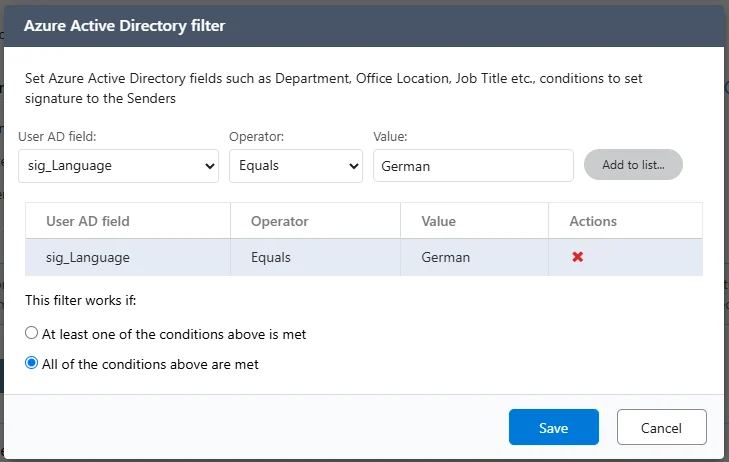
- Set language-rule priority. Position specific German, French, and Spanish rules before your general English rule. Use Rule Execution Flow to control whether processing continues after a matching rule. See the rule-priority instructions below.
How the attribute works: A user with sig_Language = German matches the German sender rule, so Sigsync applies the German signature template. The attribute is used to choose the template; you do not need to display the word “German” inside the signature. This workflow follows sender-based rule support in Centralized (Combo), Server, and Client modes.
Set rule priority for language-specific signatures
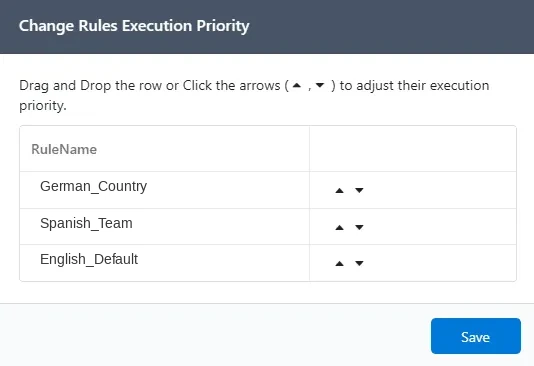
When more than one signature rule can match an email, arrange the rules so the specific language rule runs before the general English signature. For example, use German_Country for senders with Country set to Germany, Spanish_Team for the selected group, and English_Default as the general fallback.
- Create the German, Spanish, and English signature templates. In Signature Rules, create the corresponding rules and assign a language-specific template to each rule. Use the sender-based conditions described in Method 2.
- Open Signature Rules and click Priority next to Change rule execution priority, as shown below.
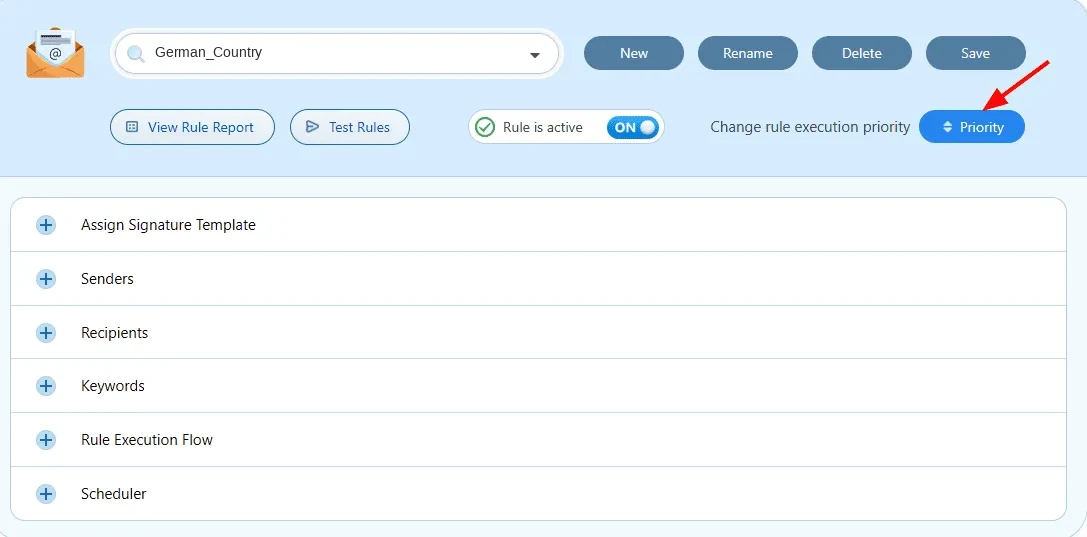
- In Change Rules Execution Priority, drag and drop the rows or use the up/down arrows to arrange German_Country first, Spanish_Team second, and English_Default last. Click Save to apply the order.
- In Rule Execution Flow, choose Stop processing the next rule when a matching language rule should prevent subsequent rules from adding another signature. This keeps the selected language signature from being followed by a general fallback signature.
For more information, see Sigsync rule priority and Rule Execution Flow.
Which Sigsync mode supports each method?
| Method | Centralized (Combo) | Server Mode | Client Mode |
|---|---|---|---|
| Recipient-based language rules | Yes | Yes | Yes |
| Sender, group or Azure AD filter rules | Yes | Yes | Yes |
| Keyword-based language rules | YesServer-side processing | YesServer-side | No |
| Choose a signature in Outlook or OWA | YesOutlook Add-in | No | YesOutlook Add-in |
| Custom attribute language rules (sig_Language) | YesAzure AD sender filter | YesAzure AD sender filter | YesAzure AD sender filter |
| Mobile Signatures | YesServer-side | Yes | No |
Recipient-based and sender-based language rules are available across Server, Centralized (Combo), and Client Modes. For Centralized Mode, keyword-based signatures use server-side processing; choosing a signature while composing uses the Outlook Add-in.
Tip: Country is a sender directory attribute, not automatic detection of the email language. When users send messages in multiple languages, they can select the appropriate signature using the Outlook Add-in in Centralized (Combo) Mode or Client Mode.
Frequently Asked Questions
How can I add email signatures in different languages with Sigsync?
Sigsync supports five workflows: rules based on recipients, rules based on senders or directory attributes, server-side keyword rules, and manual signature selection through the Sigsync Outlook Add-in. The available methods depend on whether you use Server Mode, Centralized (Combo) Mode, or Client Mode.
Can Sigsync automatically assign a German signature based on a sender’s Country?
Yes. Use a sender rule with the Azure AD Country filter set to Germany and assign the German signature template. Sender-based rules are supported in Server, Centralized (Combo), and Client Modes. The Country field is a directory attribute and does not detect the language used in the email.
Can different language signatures be assigned to selected users or groups?
Yes. Create separate language-specific signature templates and use the Senders section of Signature Rules to target Selected Senders or Senders from Group. Assign the appropriate template to each rule and check its execution priority if users may match multiple rules.
Are keyword-based signatures supported in Client Mode?
No. Keyword-based signature rules use server-side processing. They are available in Server Mode and through the server-side component of Centralized (Combo) Mode, not standalone Client Mode.
Can users select English, Spanish, or German signatures while composing in Outlook or OWA?
Yes. In Centralized (Combo) Mode and Client Mode, create and assign the language-specific signature templates and deploy the Sigsync Outlook Add-in. Users can open the Add-in while composing and choose the desired signature. This manual selection option is not available in standalone Server Mode.
Does Centralized (Combo) Mode require both connectors and the Outlook Add-in?
For the Centralized (Combo) workflow described here, configure the Exchange Online connectors and server-side rules, and also deploy the Sigsync Outlook Add-in to users who need to choose a language signature while composing. Standalone Client Mode uses the Add-in without the server-side connector configuration.
How long does it take for the Sigsync Outlook Add-in to appear after deployment?
Microsoft may take up to 72 hours to propagate the centrally deployed Outlook Add-in to users. The Add-in must be available in their Outlook client before they can manually select a language-specific signature.
How do I prioritize German, Spanish, and default English signature rules?
Open Signature Rules and click Priority. In Change Rules Execution Priority, move the specific language rules ahead of the general English rule, for example German_Country first, Spanish_Team second, and English_Default last. Save the order and configure Rule Execution Flow to stop processing later rules when only one matching signature should be applied.
Can I use Sigsync custom attributes to assign German, French, or Spanish email signatures?
Yes. In Settings & Others > Custom Attributes, create sig_Language and assign values such as German, French, Spanish, or English to your users. Prepare matching language signature templates and rules. In Signature Rules > Senders > Azure AD Filters, choose sig_Language, select Equals, enter the required language, and save to apply the correct template to matching senders.
Experience Smarter Email Signatures with a
Free Sigsync Demo
Sigsync email signature service provides effortless, centralized signature management for Office 365 and Exchange.
Our team can assist you in quickly setting up company-wide signatures. Request a free on-demand demo to see
how Sigsync can simplify your email signature management process.