
-
- Reseller
-
Products
Tailored Product Demo for Your Exact Needs
Explore how our solution delivers efficiency, control, and scalability.
Request a Demo
-
Solutions
Tailored Product Demo for Your Exact Needs
Explore how our solution delivers efficiency, control, and scalability.
Request a Demo
- Dashboard
- Features
- Pricing
Signature Based On Recipients
Sigsync Email Signature Manager allows administrators to control email signature applications based on who receives the email. Recipient-based conditions allow you to apply or exclude signatures for different audiences, ensuring the right signature is used for internal communication, external messaging, or specific recipient groups.
By configuring recipient rules, signatures can be selectively added or excluded to meet branding, compliance, or communication requirements.
Recipient Conditions
You can define recipient conditions using the following options:
- All recipients – Apply or exclude the signature for all emails.
- Internal recipients – Apply or exclude the signature for emails sent within the organization.
- External recipients – Apply or exclude the signature for emails sent outside the organization.
- Recipients from Group – Apply or exclude the signature for recipients belonging to specific groups.
- Email addresses or Domain – Apply or exclude the signature for specific email addresses or domains.
Recipient-based conditions can be configured in two ways. Refer to the sections below for detailed instructions:
Add Signature - based on Recipients
Sigsync provides an option to include the signature based on recipients. This applies if the recipient matches any of the following options: All recipients, Internal recipients, External recipients, Recipients from Group, Email addresses.
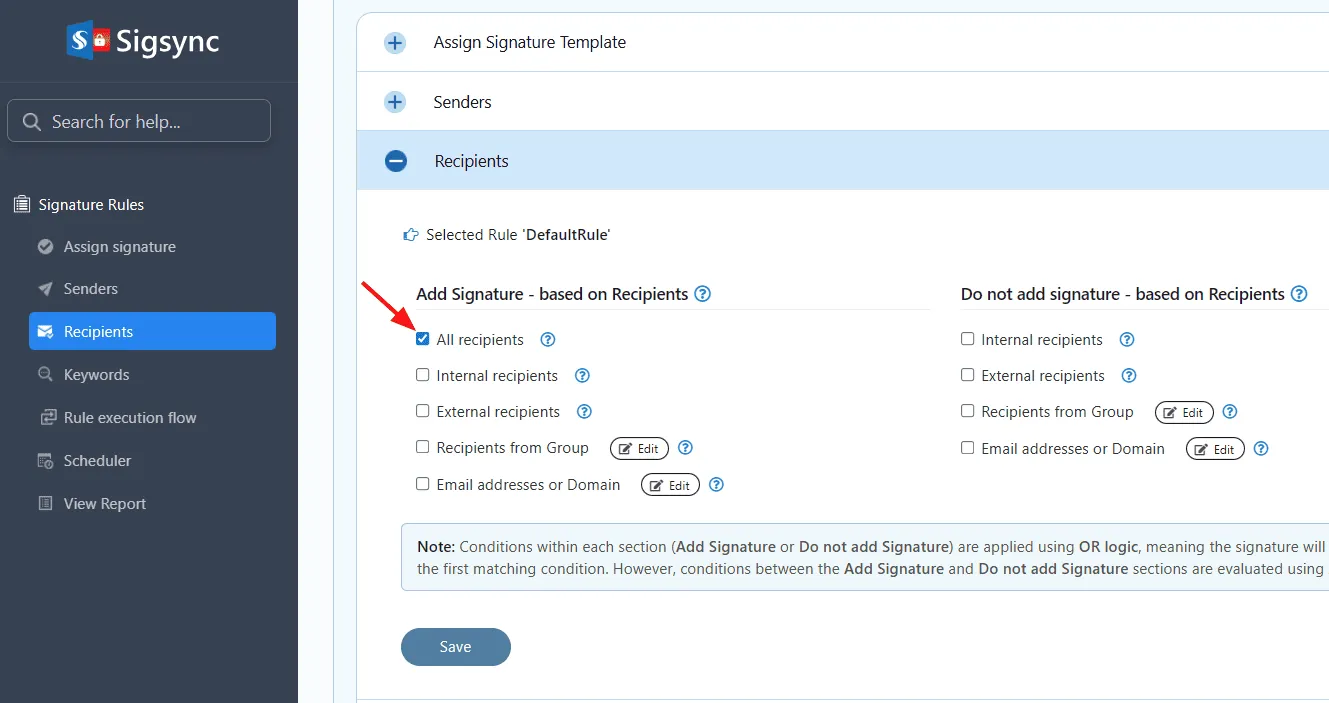
All recipients
‘All recipients’ option applies the signature to all outgoing emails sent to any recipients, including To, CC, and BCC. This ensures the signature is consistently added to every email, regardless of who the recipient is.
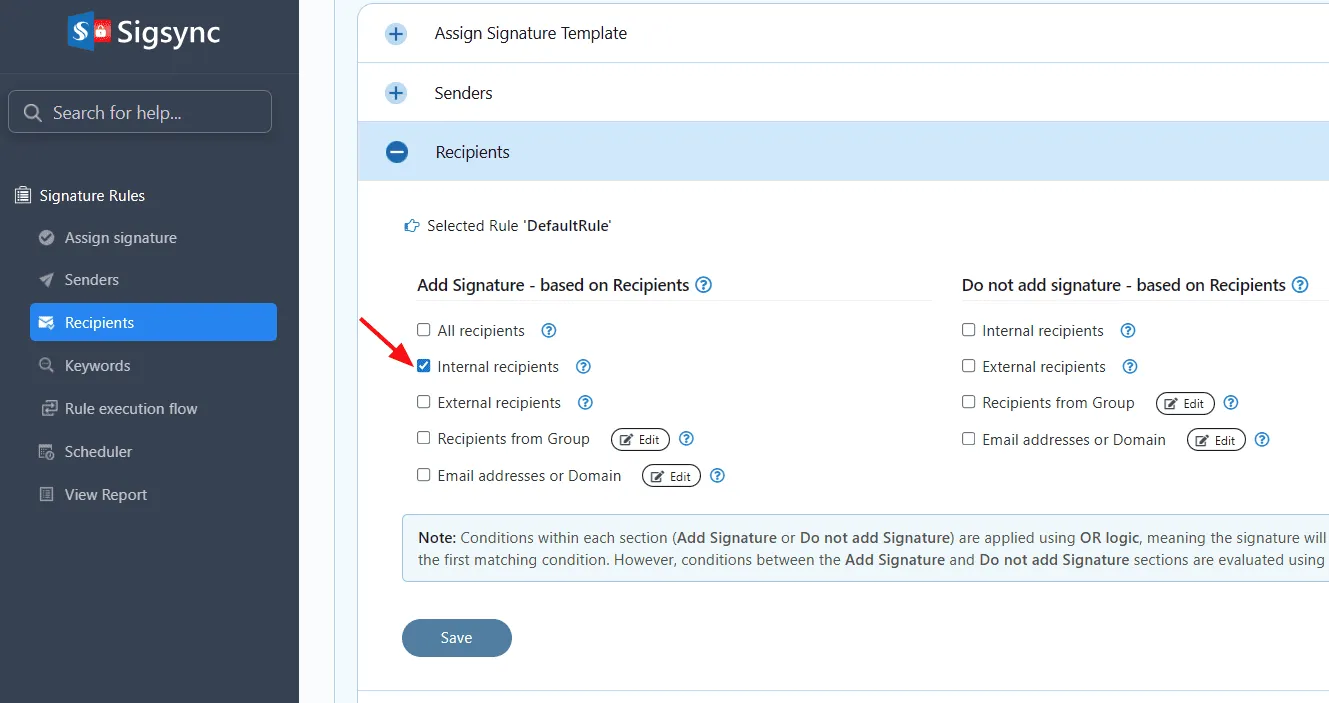
Internal recipients
‘Internal recipients’ option adds the signature only to emails sent within your organization. Internal recipients are email addresses that belong to domains associated with your Office 365 tenant. For example, ‘email@domain1.com’ is considered an internal recipient if ‘domain1.com’ is added to your Office 365 tenant.
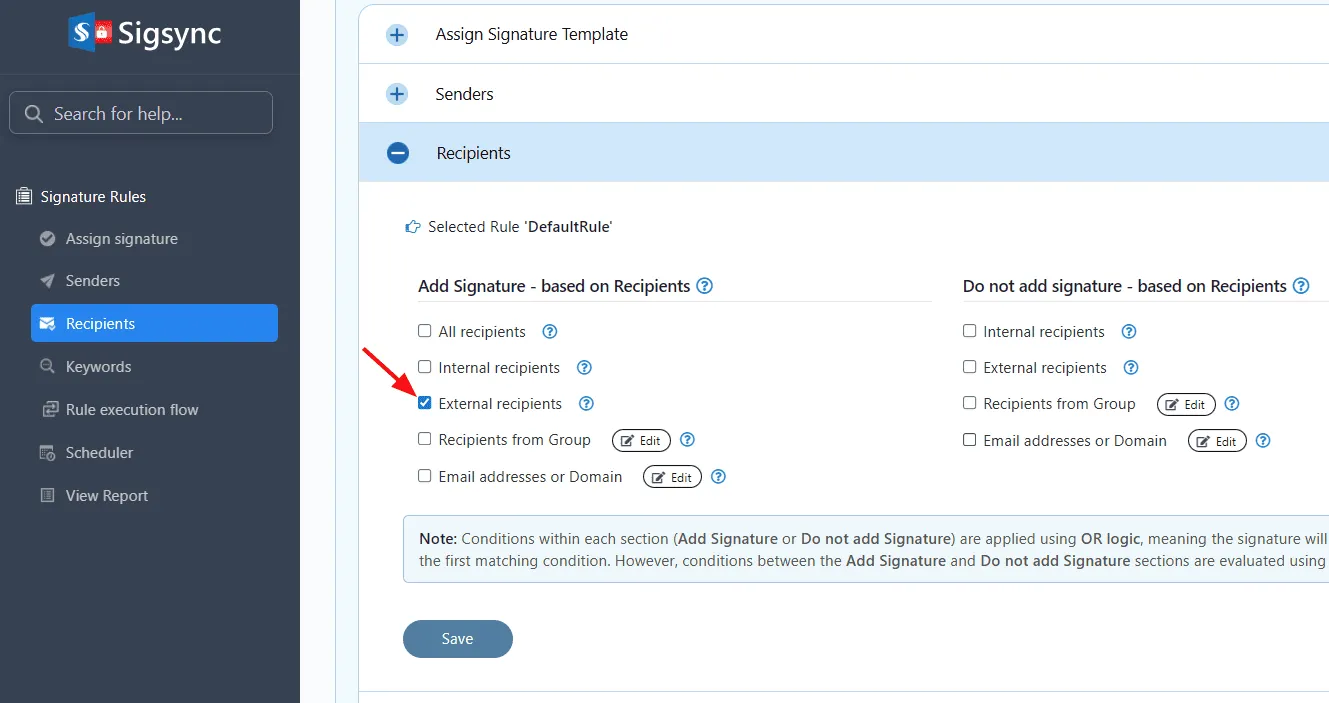
External recipients
‘External recipients’ option adds the signature only to emails sent outside your organization. External recipients are email addresses that belong to domains not associated with your Office 365 tenant. For example, ‘email@domain2.com’ is considered an external recipient if ‘domain2.com’ is not added to your Office 365 tenant.
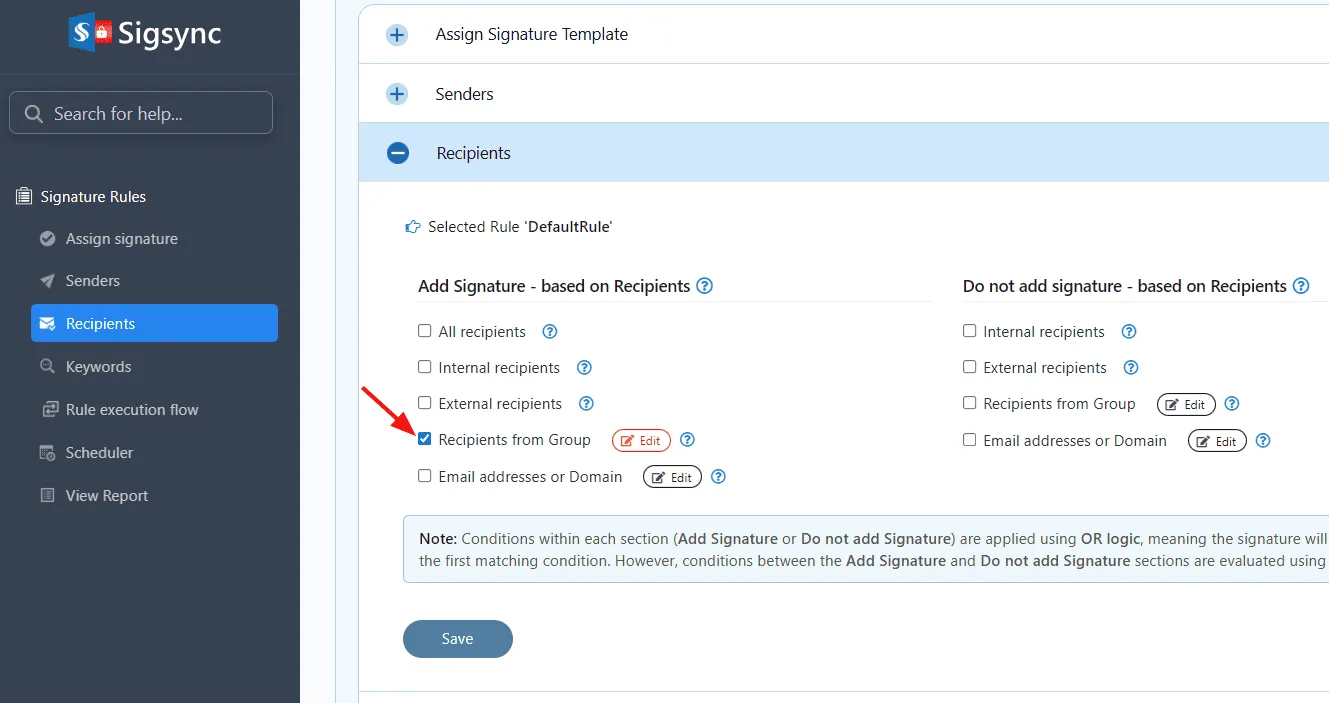
Recipients from Group
‘Recipients from Group’ option adds the signature specifically to recipients who are members of the selected Office 365 group. The signature will only be applied to emails sent to individuals within the chosen group, ensuring it is included for relevant recipients in your organization.
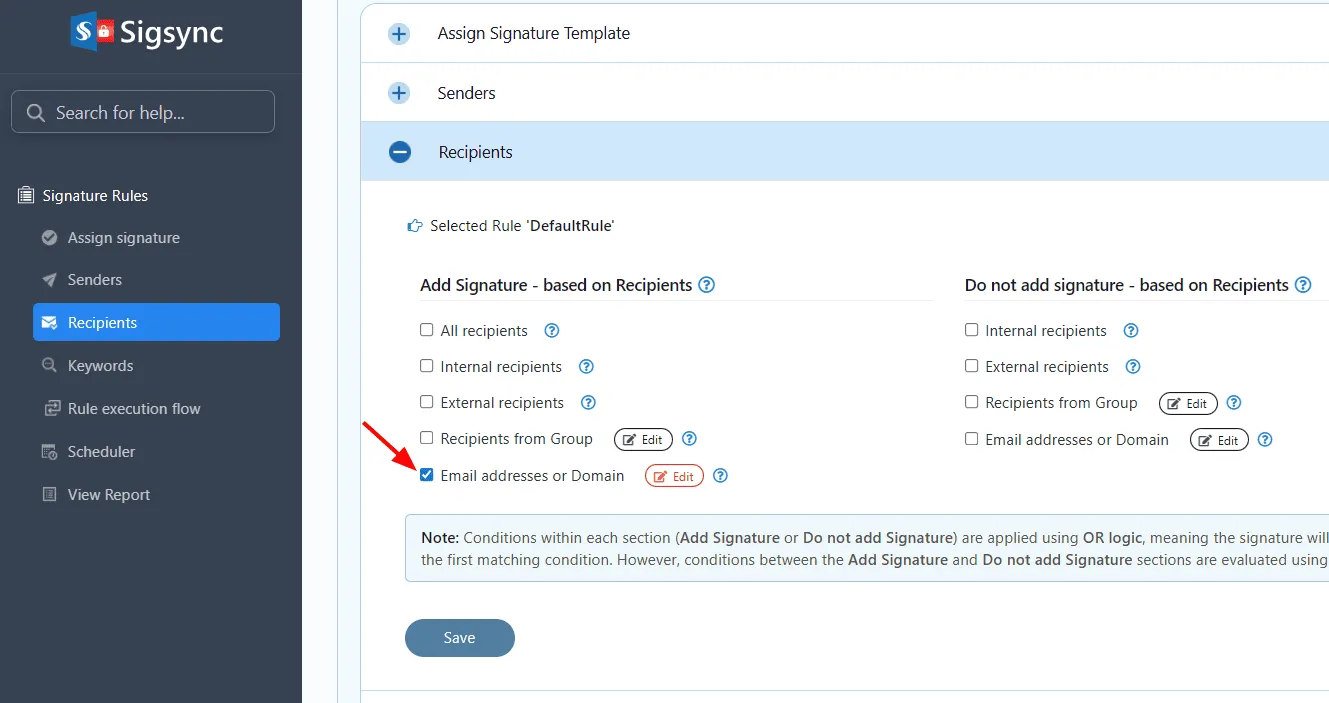
Email addresses or Domain
‘Email addresses or Domain’ option adds the signature to the specific email addresses or domain. Click the ‘Edit’ icon, enter the email addresses (e.g., email@domain.com) or a domain (e.g., test.com) in the popup window, and add them to the list. Then, click the ‘Save’ button to apply the changes.
Do not add signature – based on Recipients
Sigsync allows you to exclude the signature based on the recipients. This applies if the recipient matches any of the following options: Internal recipients, External recipients, Recipients from Group, Email addresses.
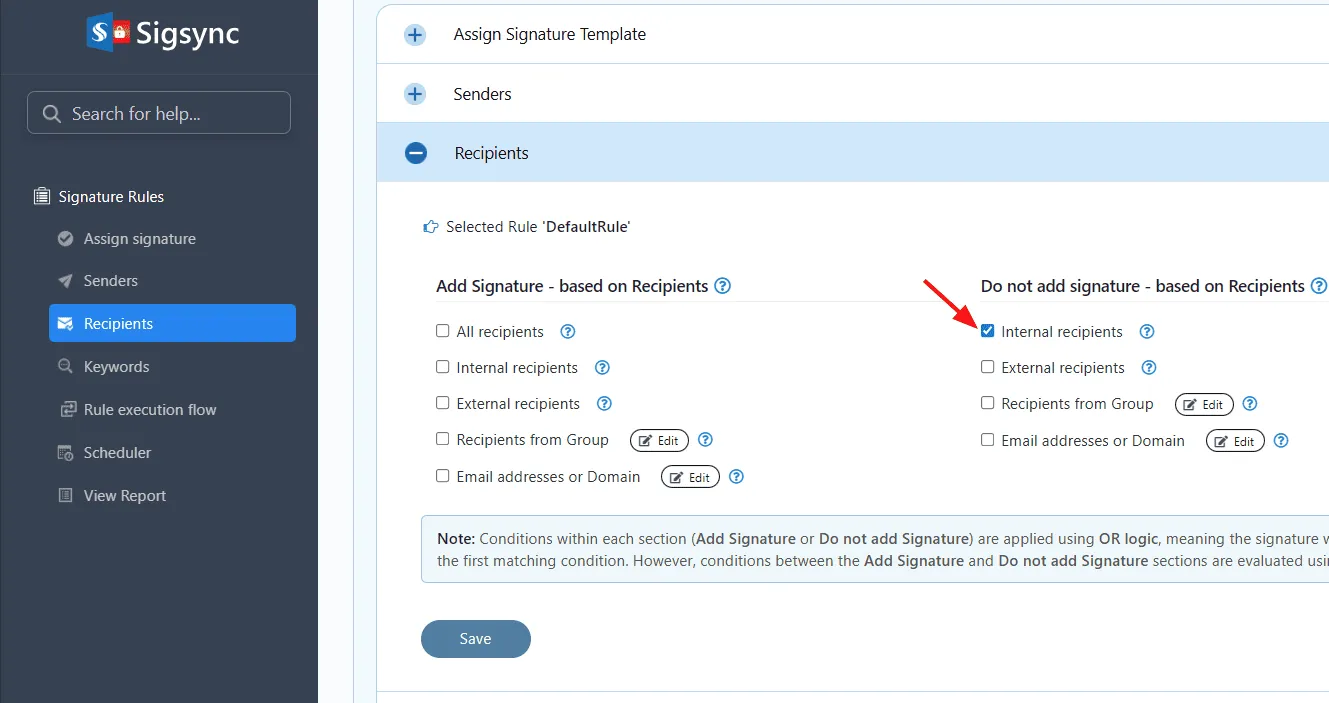
Internal recipients
Excludes adding signatures only to the internal recipients. Internal recipients are email domains belonging to your tenant. For example, email@domain1.com. Here, domain1 is internal if it's added in your Office 365 tenant.
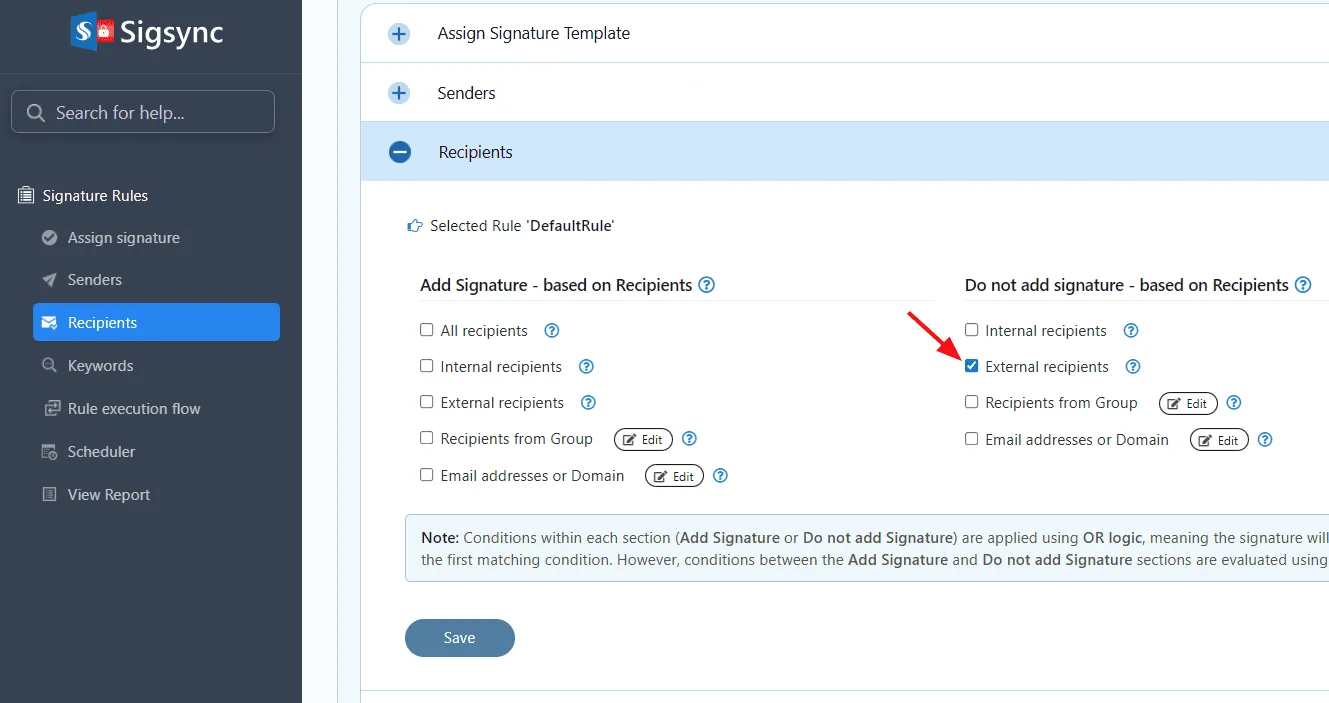
External recipients
Excludes adding signatures only to the external recipients. External recipients are those email domains not belonging to your tenant. For example, email@domain2.com. Here, domain2 is external if it's not added in your Office 365 tenant.
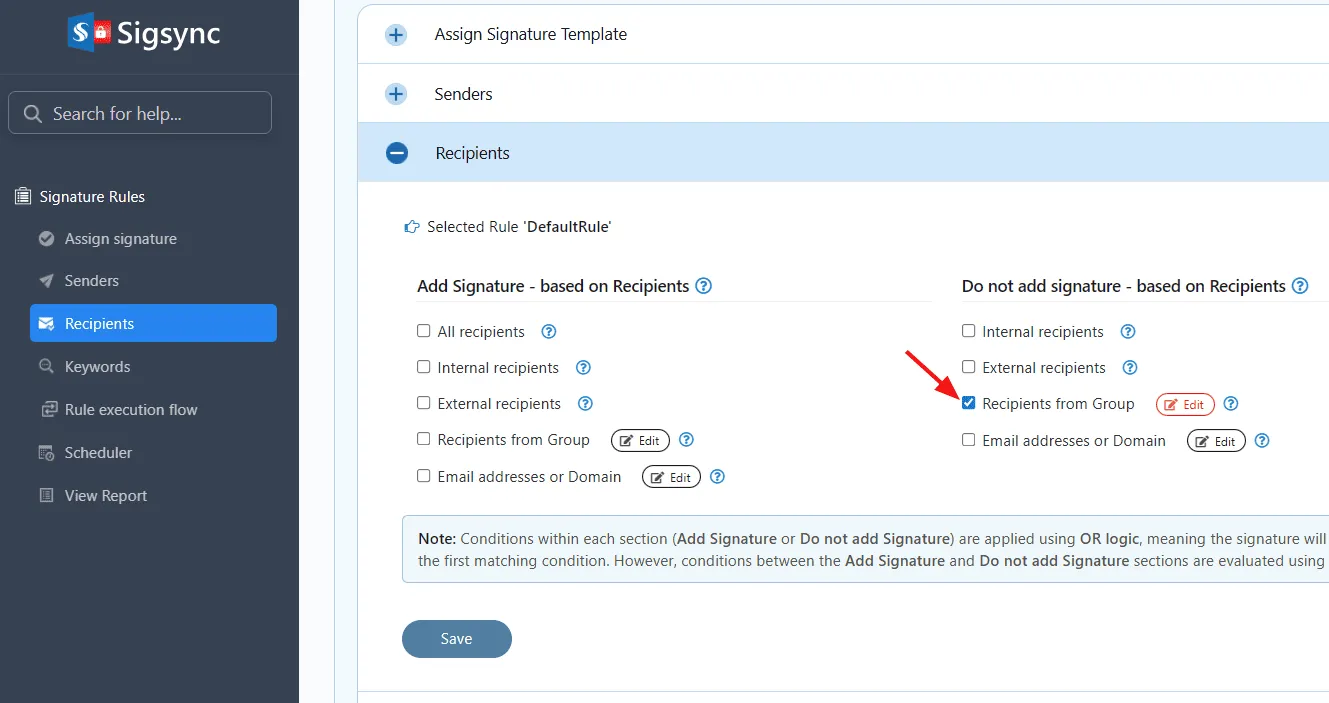
Recipients from Group
Excludes adding signatures to the recipients who are members of the selected Office 365 group.
Email addresses or Domain
‘Exclude Email addresses or Domain’ option allows you to exclude the signature from specific email addresses or domains. Click the ‘Edit’ icon, enter the email addresses (e.g., email@domain.com) or a domain (e.g., test.com) in the popup window, and add them to the exclusion list. Then, click the ‘Save’ button to apply the changes.
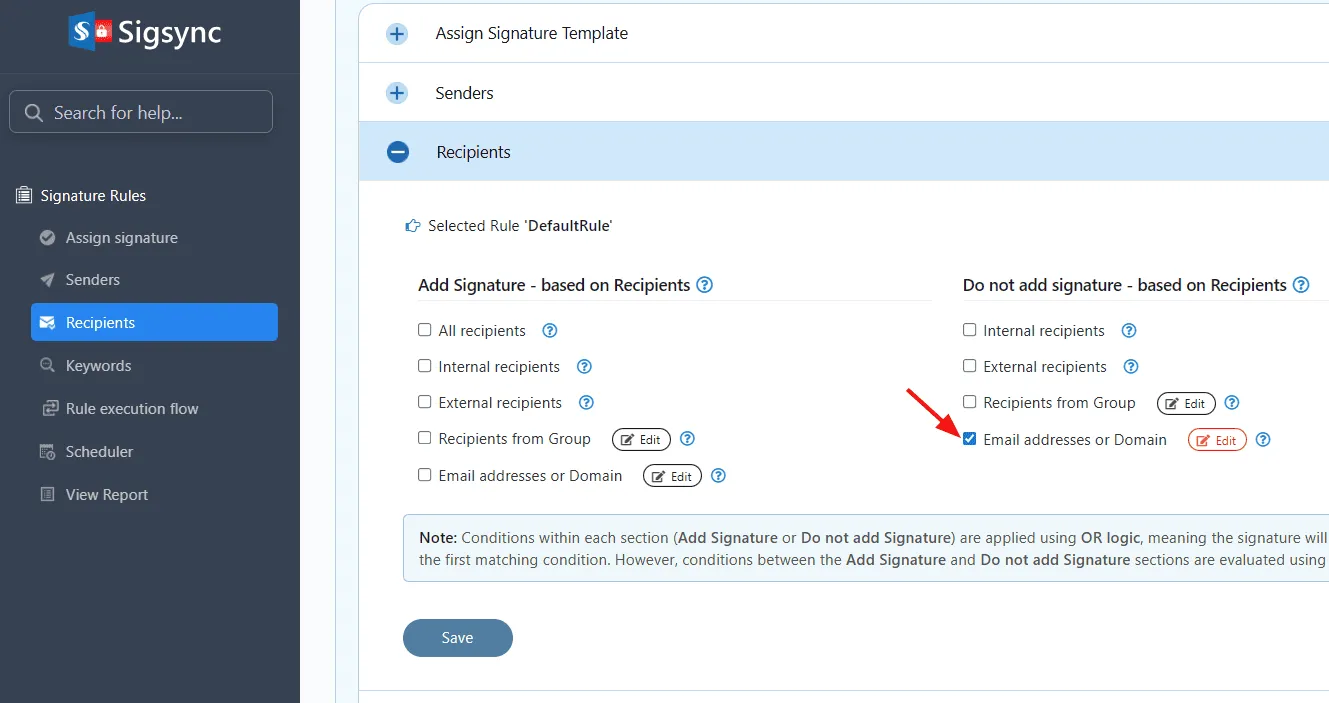
Note: Conditions within each section (Add Signature or Do not add Signature) are applied using OR logic, meaning the signature will be applied based on the first matching condition. However, conditions between the Add Signature and Do not add Signature sections are evaluated using AND logic.
Next Navigate to:
In this manual