-
- Reseller
-
Products
Tailored Product Demo for Your Exact Needs
Explore how our solution delivers efficiency, control, and scalability.
Request a Demo
-
Solutions
Tailored Product Demo for Your Exact Needs
Explore how our solution delivers efficiency, control, and scalability.
Request a Demo
- Dashboard
- Features
- Pricing
Company-Wide Office 365 Email Signature Setup with Sigsync
A company-wide signature rollout needs a consistent design, accurate Microsoft 365 user data, clear rules for who receives each signature, and a deployment method that matches how your users send email. This guide briefly covers Microsoft's native options, then shows how Sigsync can be used to build and apply company-wide Office 365 signatures from a centrally managed setup.
Microsoft 365 gives users native Outlook signatures and gives administrators Exchange Online mail flow rules that can append organization-wide signature or disclaimer content. These approaches are useful for basic requirements, but they solve different parts of the signature workflow.
This guide covers both native methods and a Sigsync-based setup. It also explains where the native Exchange Online disclaimer method has limitations, so you can choose an approach that fits your organization-wide Office 365 signature requirements.
For organizations that need centralized templates, directory-based personalization, signature rules, and flexible deployment options, Sigsync Microsoft 365 Email Signature Software provides a centralized approach to applying consistent email signatures across Microsoft 365 users.


Set up an email signature for Office 365
Follow these steps to create an email signature in Outlook :
- Launch Outlook and select 'File' > 'Options'
- Navigate to the Mail section and click the Signatures.. button next to Create or modify signatures for messages.
- Create a signature in the Edit signature section.
- You can add images, links, icons and modify the formatting of the signature.
- The signature created for the very first time will be named Default, which can be renamed using the Rename button.
- Select a default signature and link it to your email account.
- You can choose a signature for new emails and for replies and forwards.
- Start adding Office 365 signatures when you compose an email
See detailed steps for creating and adding email signatures for messages in Outlook

If you do not want the signature to be added automatically, you can insert it manually using the 'Insert' tab. Select the 'Signature' option in the email window, then select the signature you want to attach.
Follow these steps to create Office 365 signature using Outlook Web App :
- Click the Settings (⚙️) icon in the top-right corner.
- Go to Account > Signatures.
- Create your signature in the 'Email signature' text box.
- Click the + Add Signature button and create your signature.
- Select the Set default for new messages option and click Save to start adding signatures to your emails.
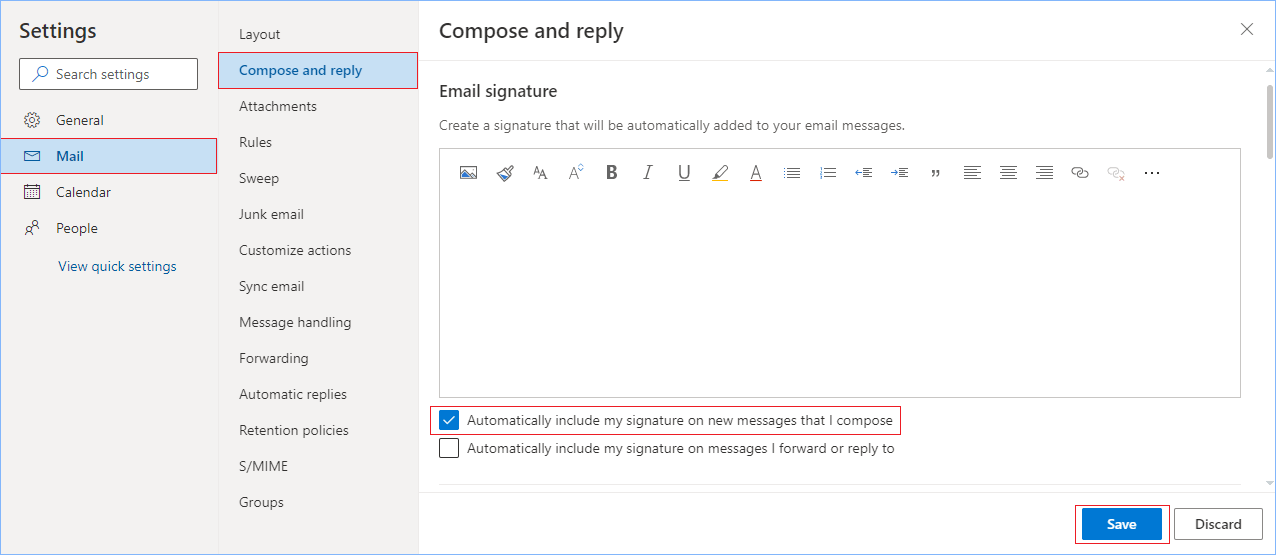
If you do not want the signatures to be added automatically for new messages, you can insert the signature manually by using the 'Insert' option available at the top of an email.
A company-wide email signature is better suited for managing signatures across your entire organization. They can standardize the look of emails and ensure that all emails have the same layout and appearance. A consistent email signature and an organization-wide disclaimer ensure that your email signature is both professional and compliant.
Native Microsoft 365 Option for Company-Wide Signatures
Exchange Online administrators can use a mail flow rule to append or prepend organization-wide signature or disclaimer content. This can be suitable for a basic centrally applied footer when a separate signature service is not required.
In the Exchange admin center, create an Apply disclaimers rule, define the required senders or recipients, add the HTML/text and supported sender attributes, choose the fallback action, and test the rule before wider use.
For the current Microsoft procedure and supported options, refer to Microsoft's documentation for organization-wide signatures and disclaimers in Exchange Online.
Where the Native Microsoft 365 Method Has Limitations
The Exchange Online disclaimer method is useful for basic server-side footer content, but it is not a complete company-wide signature workflow. The signature is not visible to the sender while composing, it cannot be positioned directly below the latest reply or forward, and the server-added version is not shown in the sender's Sent Items copy.
Organizations that need centrally designed templates, compose-time visibility, directory-driven personalization, different signatures for different business scenarios, and more control over deployment can use Sigsync for the company-wide signature workflow.
Set up company-wide Office 365 signatures with Sigsync
With Sigsync, administrators can build the company-wide signature workflow around the Microsoft 365 tenant, centrally maintained templates, directory data and signature rules. The existing three-step setup is:
- Step 1: Add your Microsoft 365 tenant to Sigsync

- Step 2: Create or customize the company email signature in the Sigsync signature editor

- Step 3: Configure the signature for the required users and email scenarios

After the tenant and template are ready, choose how Sigsync should apply the signature. Server Mode applies signatures after sending, Client Mode inserts them while composing in supported Outlook clients, and Centralized Mode combines both approaches. Centralized Mode is the recommended option when you need compose-time visibility together with server-side coverage. Use signature rules to control which template is applied for the required senders, recipients and other supported conditions. For the detailed configuration sequence, see the Sigsync Office 365 email signature setup guide.
How Sigsync handles company-wide signature requirements
After the Microsoft 365 tenant and signature template are ready, administrators can control how signatures are personalized, assigned and applied across the organization.
- Centralized administration: Manage templates and signature settings from the Sigsync web dashboard instead of maintaining separate local signatures for individual users.
- Flexible deployment: Choose Server, Client or Centralized Mode based on whether signatures should be applied after sending, shown while composing, or handled through both approaches.
- Delegated administration: Assign tenant-specific administrators when separate Microsoft 365 tenants or administrative responsibilities need independent control.
- Directory personalization: Populate supported fields such as names, job titles, phone numbers and other user details from Microsoft 365 directory data.
- Conditional fields: Hide fields when directory values are empty so missing user information does not leave unnecessary gaps in the signature.
- Outlook compose-time visibility: Use the Sigsync Outlook Add-in with Client or Centralized Mode when supported Outlook users need to see the signature while composing.
- Signature rules: Apply the appropriate template using supported sender, recipient, domain and other conditions for different teams and communication scenarios.

Microsoft 365 Native Signatures vs Sigsync for Company-Wide Signatures
| Requirement | Microsoft 365 Native Options | Sigsync Email Signatures for Office 365 |
|---|---|---|
| Individual signature while composing | Available through Outlook signature settings | Available in supported Outlook clients when using Client or Centralized Mode |
| Organization-wide server-side signature/disclaimer | Available through Exchange Online mail flow rules | Available through Server Mode or Centralized Mode according to the configured rules |
| Signature directly below latest reply or forward | Not supported by the Exchange Online disclaimer method | Supported through Sigsync signature layout and deployment options |
| Server-side signature visible in Sent Items | Not shown in the sender's Sent Items copy when added by the Exchange Online disclaimer rule | Sent Items signature handling is available for supported Sigsync configurations |
| Central template editor | Mail flow disclaimer content is configured in Exchange; individual Outlook signatures are maintained separately | Templates can be created and maintained in the Sigsync signature editor |
| Directory-based personalization | Exchange Online disclaimer rules support a defined set of sender attribute tokens | Directory placeholders can be used with conditional handling for empty values |
| Different signatures by audience or business rule | Mail flow conditions and exceptions can scope disclaimer rules | Signature rules can target supported sender, recipient, domain and other conditions |
| Delegated signature administration | Managed through Microsoft 365 / Exchange administrative permissions | Global and tenant-specific Sigsync administration can be delegated |
Maintain Company-Wide Signatures After Deployment
After deployment, signature changes can be handled from the Sigsync dashboard rather than asking every employee to edit an Outlook signature. Administrators can update centrally maintained templates, adjust signature rules, and revise branding or disclaimer content as requirements change.
For organizations with multiple Microsoft 365 tenants or separate administration responsibilities, Sigsync also supports delegated administration. This keeps the page focused on the practical company-wide setup and maintenance process rather than turning it into a general Microsoft 365 administration guide.
Experience Smarter Email Signatures with a
Free Sigsync Demo
Sigsync email signature service provides effortless, centralized signature management for Office 365 and Exchange.
Our team can assist you in quickly setting up company-wide signatures. Request a free on-demand demo to see
how Sigsync can simplify your email signature management process.