

Signature Component Properties
Sigsync Signature Generator empowers administrators and users to build professional, visually-appealing email signatures for Office 365 without writing any HTML code. Within the signature generator, the Properties Panel is where you control the appearance and behavior of each signature component added to the template. Once a component, such as text, images, icons, banners, or dynamic user fields is selected, the relevant property options are shown for customization.
The Properties Panel allows you to update fonts, text size, colors, alignment, spacing, padding, margin, borders, background settings, links, and element dimensions from a single place. It also supports dynamic Azure AD fields, so user information is automatically filled and kept up to date. Layout options like rows, columns, and line breaks help structure the signature properly, while display settings hide empty fields. These options help keep email signatures consistent, readable, and professional across all users.
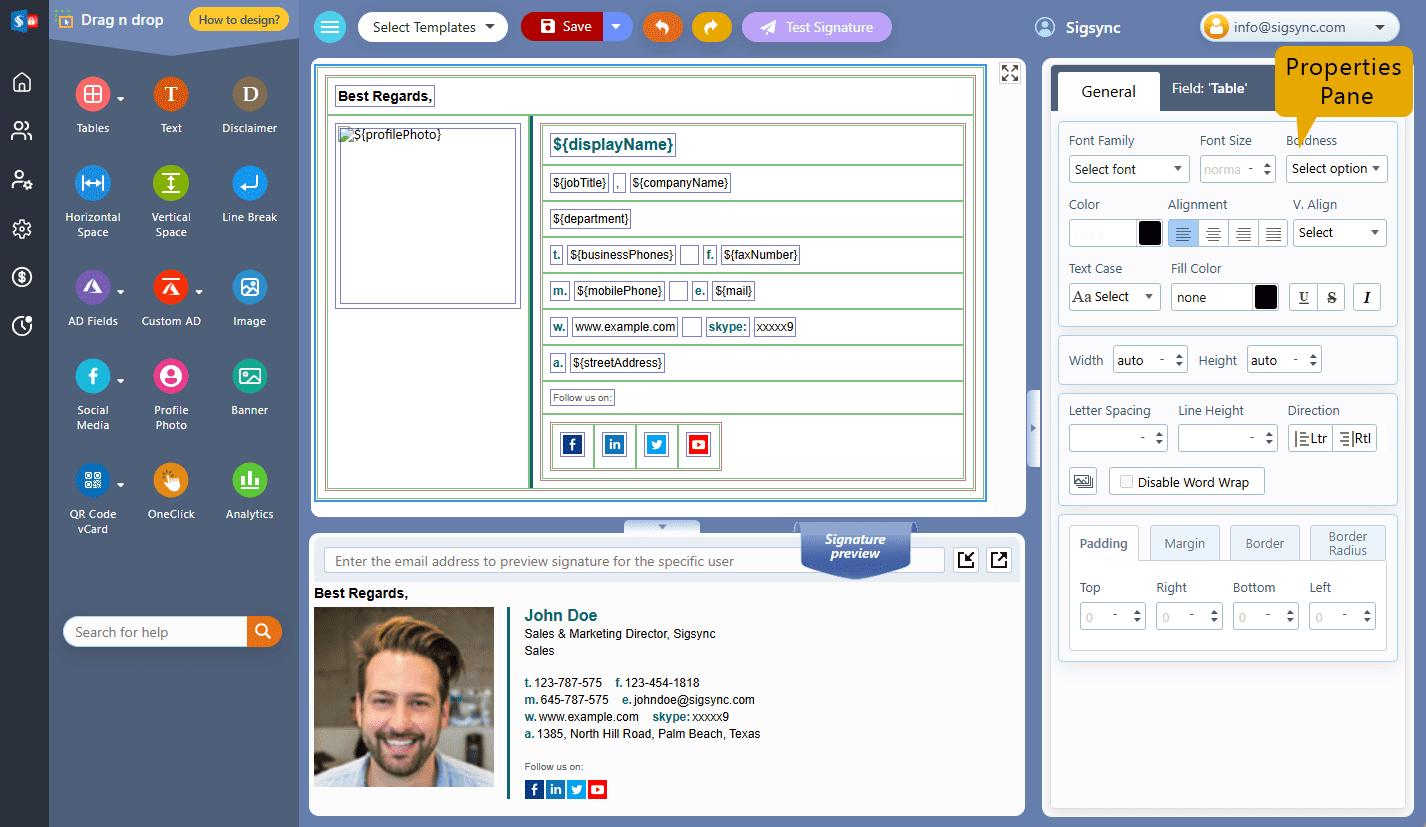
The Properties Panel offers the following set of properties for signature components:
- Fonts & Color
Using the correct fonts and colors helps your email signature look clear, consistent, and professional across all email clients. These properties allow you to control how text and background elements appear in the signature.
- Font Family: Sigsync provides multiple font family options, ensuring your email signature remains consistent and readable across different email clients.
- Font Size: This option allows you to increase or decrease the size of the selected signature field, helping control how prominent or subtle the text appears.
- Boldness: Adjust the thickness of the text to emphasize key details such as names or job titles within the signature.
- Color: Change the text color of the signature field to align with brand colors or improve readability.
- Fill Color: Apply a background color behind the selected signature field to highlight sections and enhance the overall visual structure.
- Font Style: Choose how text is displayed using Normal, Italic, or Underline styles to add emphasis or highlight specific signature content.
- Alignment & Text Decoration
This section controls how text is positioned and displayed within a signature component. These properties help align content properly and improve readability across different email clients.
- Vertical Alignment: This property lets you align the text vertically within the selected field, such as top, middle, or bottom alignment.
- Horizontal Alignment: Use this option to align text horizontally within the signature field, including Left, Center, Right, or Justify alignment.
- Letter Spacing: Allows you to adjust the space between characters, helping improve clarity or match branding requirements.
- Line Height: This property controls the space between lines of text, making the content easier to read and visually balanced.
- Text Case: Lets you control the capitalization of text. You can choose None, Capitalize, Uppercase, or Lowercase.
- Direction: Defines the text direction, such as left-to-right or right-to-left, which is useful for different language formats.
- Height, Width & Padding
These properties define the size and spacing of each signature component, helping you create a clean and organized layout.
- Width: The Width property determines the horizontal size of the signature field. You can set it in specific units, such as pixels or inches, to make the field exactly the size you need.
- Height: The Height property determines the vertical size of the signature field. Like width, it can be set in pixels or inches to ensure the field fits perfectly in the signature layout.
- Padding: Controls the space between the signature field and surrounding content. Top and Bottom adjust vertical spacing, while Left and Right adjust horizontal spacing. Adjusting these values helps position the field correctly and keeps the signature neat and professional.
- Border (Line Separator)
Borders help define the edges of signature components and separate different sections like contact details, social icons, or other elements for better clarity.
- Border: This property lets you add and customize borders on all sides of a signature component. You can set borders individually for the top, right, bottom, or left side, or apply the same style to all sides at once. You can also adjust the border color, thickness, and style based on your design.
- Border Radius: Controls how rounded the corners of a component appear. Increasing the radius creates softer, rounded corners, while a smaller radius keeps them sharper. This is useful for images, logos, or sections that need a smoother look.
- Border Collapse: Determines how borders behave between adjacent signature fields. When set to Separate, each field keeps its own distinct border. When set to Collapse, the borders between fields merge, creating a seamless look without gaps.
- Background Image
The Background Image property lets you add a custom image as the background of your email signature, helping to enhance branding or visual appeal.
- Repeat: Controls how the background image is repeated within the signature field: both horizontally and vertically (repeat), only horizontally (repeat-x), only vertically (repeat-y), or no repeat (no-repeat).
- Position: Determines the placement of the background image within the signature. You can align it to the left, center, or right, based on how you want it displayed.
- Attachment: Specifies whether the background image stays fixed when scrolling or moves along with the email content.
- Size: Controls how the background image fits the signature area. Options include cover to fill the space or contain to display the entire image while keeping its aspect ratio.
- Edit Dynamic (Azure AD) fields
The Edit Dynamic (Azure AD) fields property lets you control how user information from Azure Active Directory (AD) appears in your email signature. Instead of manually entering user details for every signature, dynamic fields automatically pull this data from Azure AD and insert it into the template.
- Azure AD Field: This option lets you select and use a specific attribute from Azure Active Directory for a signature field. You can replace one AD attribute with another — for example, change the job title field to show the company name instead.
- Static Field: Use this when you want to display a fixed value that doesn’t come from Azure AD. For example, you might use a company phone number or a generic text that stays the same for all users.
- Static Profile Photo: This option allows you to insert a manually uploaded image instead of fetching the user’s profile photo from Azure AD. This is useful when you want a specific image, such as a logo or custom picture, rather than the individual user’s profile photo.
- Hyperlink
The Hyperlink property allows you to make any signature field clickable, directing recipients to a website, email address, or other destination. You can add the URL and an optional tooltip for the link, so users know where it will take them. This makes it easy to include links to your company website, support page, or social profiles directly in the email signature.
- Display / Hide Signature fields
Sigsync provides a feature to help keep your email signatures clean and consistent. In the signature editor, the ‘Visibility’ property tab lets you hide any fields that do not have data in your Office 365 Azure Active Directory, ensuring that empty fields do not appear in your signature.
- Row & Column Operations
Sigsync lets you organize the layout of your signature using rows and columns, so you can structure information like contact details, images, icons, and other elements in a neat and balanced way. Within the signature editor, you can access options to split, merge, insert, or delete rows and columns to change how the content is arranged.
- Merge Cells: Combine two or more adjacent cells into a single larger cell. This is useful when you want a field to span across multiple columns.
- Insert Row: The Insert Row feature allows you to add a new row directly below the currently selected row in your email signature table.
- Delete Row: The Delete Row property allows you to remove a row from a table within your email signature.
- Split Cells: The Split Cells feature allows you to divide a single cell into multiple rows or columns within your email signature table.
- Insert Column: The Insert Column feature allows you to add a new column directly to the right of the currently selected column in your email signature table.
- Delete Column: The Delete Column property in the Sigsync editor allows you to remove a specific column from a table.
- Edit Social Media Icon
The Edit Social Media Icon feature lets you add, remove, or change social media icons in your email signature. You can choose from popular platforms such as LinkedIn, Twitter, Facebook, Instagram, YouTube, and more.
This feature also allows you to customize the icons’ appearance by adjusting their size, color, and alignment. You can add hyperlinks to each icon so that recipients can directly visit your social media profiles from your email signature.
- Edit OneClick Survey
The Edit OneClick Survey feature in Sigsync lets you customize the customer feedback survey that appears in your email signature. This survey is designed to collect feedback with a single click, making it easy for recipients to respond and for you to gather insights.
When you select the OneClick survey field in the signature editor and open the Edit OneClick Survey property, you can modify the survey’s layout, design, and HTML code to match your business style and needs before applying it to your signature.
Next Navigate to:
In this manual