

Sigsync Office 365 Email Signature Editor — Overview
The Sigsync Office 365 Email Signature Editor is a powerful, web-based editor designed to help organizations create professional, consistent, and dynamic email signatures for Microsoft 365 users. It removes the complexity of HTML design and manual signature updates by offering a visual, drag-and-drop signature builder that works seamlessly with centralized signature management. This tool is suitable for businesses of all sizes that want to standardize email signatures, maintain brand consistency, and simplify ongoing updates.
This tool is suitable for businesses of all sizes that want to standardize email signatures, maintain brand consistency, and simplify ongoing updates.
Why Use the Sigsync Signature Editor?
Creating email signatures manually for each user often leads to inconsistent branding, outdated contact details, and increased administrative effort. The Sigsync Signature Editor addresses these challenges by offering a centralized and automated approach. The following listed points are the key benefits of using the Sigsync Signature Editor:
- Eliminates the need for coding knowledge
- Ensures consistent branding across all users
- Reduces IT and administrative workload
- Supports dynamic, user-specific signature content
- Provides a real-time preview and testing before deployment
User-Friendly WYSIWYG Editor
The Sigsync Signature Editor features a What You See Is What You Get (WYSIWYG) editor that allows you to design email signatures visually, ensuring the final product looks exactly as intended. This visual editing approach removes complexity and helps create accurate, professional signatures without technical effort.
The WYSIWYG editor simplifies signature creation by offering the following features:
- Live editing with instant visual feedback
- Easy layout adjustments using drag-and-drop and toolbar components
- A clean and intuitive interface for faster signature creation
- No risk of broken HTML or formatting inconsistencies
This ensures the tool is easy to use for both technical and non-technical users.
Watch our video tutorial to learn how to use the editor to design a professional email signature template from scratch, or continue exploring all components.
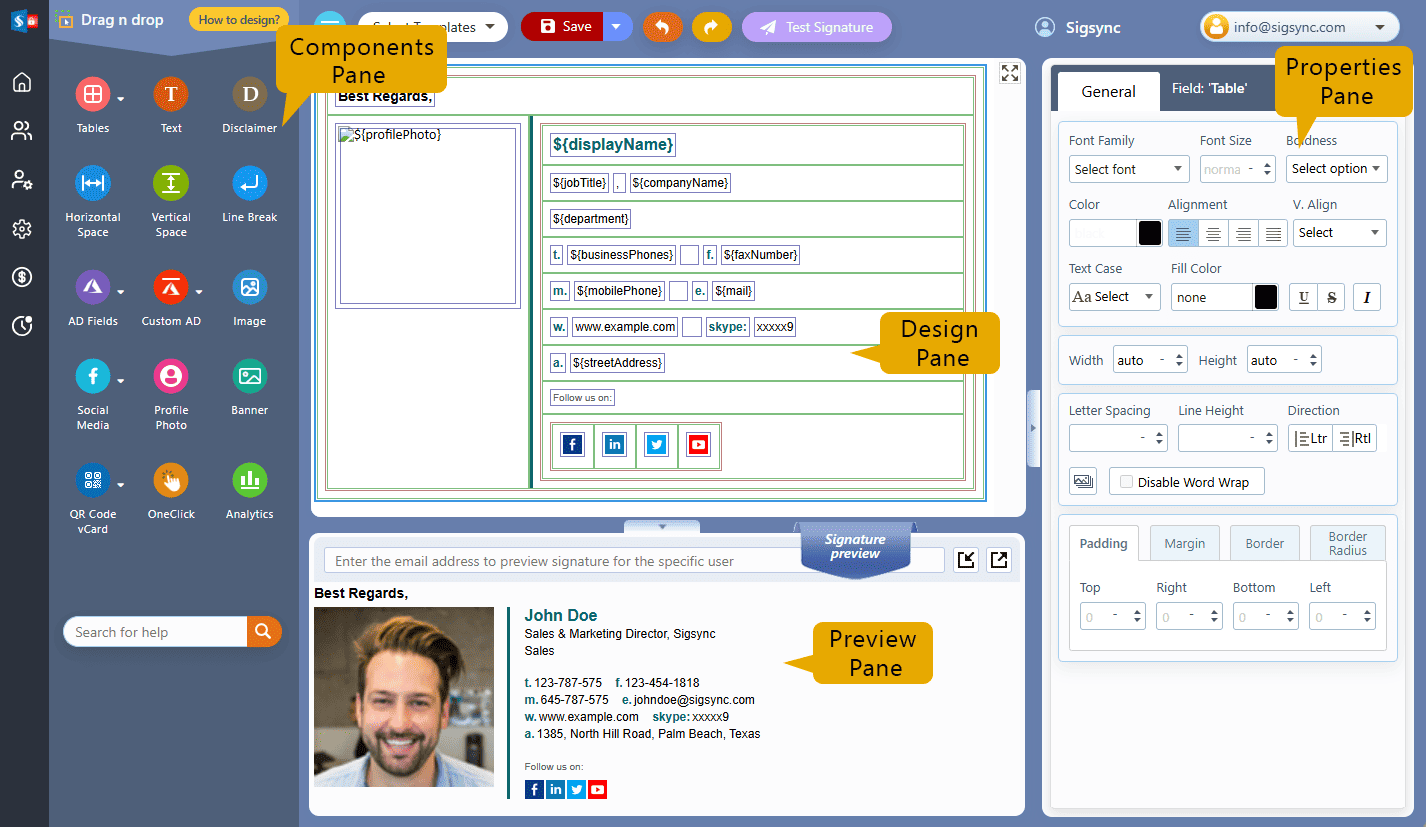
You have full creative control over your email signatures, with the ability to customize fonts, colors, images, logos, and social media icons. To make the design process even easier, the editor is organized into intuitive sections, each serving a specific purpose:
- Components Pane
- Design Pane
- Properties Pane
- Preview Pane
- Components Pane:
The Components Pane in the Sigsync Editor allows you to effortlessly add elements to your email signature by dragging and dropping them onto the Design Pane. This intuitive approach streamlines signature creation, removing the need for coding or manual formatting and making it easy to build professional signatures.
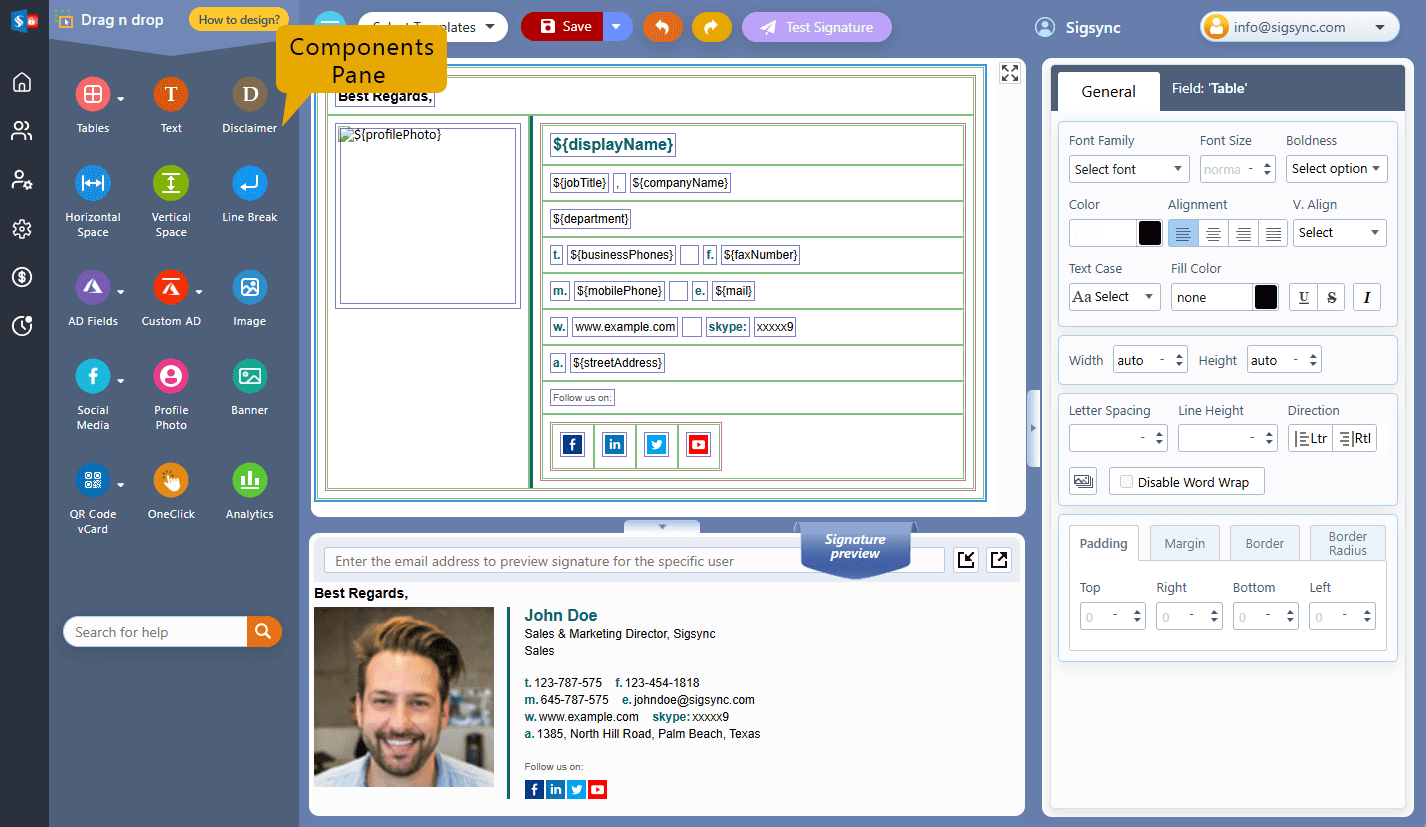
The list of drag and drop components are:
- Tables: Organize your signature layout using tables. Create separate sections for contact information, company logos, or any other structured content.
- Text & Disclaimer: Add custom text or legal disclaimers directly into your signature. This ensures that all communications comply with company policies, legal requirements, and regulatory guidelines while maintaining a professional appearance.
- Space & New Line: Use spacing and new lines to separate signature elements and establish a clear visual hierarchy. Proper spacing improves readability and ensures that each section of the signature is visually distinct. This includes:
- Horizontal Space: Creates a blank space that stretches horizontally across your signature.
- Vertical Space: Creates a blank space that stretches vertically across your signature.
- Line Break: Allows you to insert a line break between signature fields.
- Dynamic Fields: Dynamic field components retrieve user and message-related information directly from Office 365 and insert it into the email signature automatically.
- AD Fields: Pulls Active Directory details such as name, profile image, job title, and dynamically loads them into the email signature template.
- AD Personal: Inserts a group of personal fields at once, such as display name, job title, and company name.
- AD Address: Inserts a group of address fields into the template, including street address, city, state, and country.
- AD Contact: Inserts a group of contact fields such as business phone, fax number, mobile number, email address, and website.
- Custom AD: Allows you to insert custom attributes into the signature template and automatically fetches the details from Office 365.
- Message Properties: Dynamically inserts required message properties into the email signature.
- Images & Icons:Include visual elements such as company logos, profile photos, banners, and custom icons in your email signature to support consistent branding and improve visual presentation.
- Image: Add images such as company logos or other visual elements to the email signature.
- Profile Photo: Display the sender’s profile photo within the email signature.
- Banner: Insert a banner image to highlight branding, announcements, or promotions.
- Social Media: Add links to your social media profiles along with their respective icons to make it easy for recipients to connect with your organization and engage with your online presence.
- Icon: Displays individual social media icons that link to your selected platforms.
- Stripe: Displays social media icons arranged in a horizontal or vertical layout for a clean and consistent appearance.
- QR Code: Generate a scannable QR code that links to contact details, websites, or landing pages, allowing recipients to quickly access important information.
- QR Code: Creates a QR code that directs recipients to a specified URL or online resource.
- vCard: Generates a QR code that allows recipients to save contact details directly to their address book.
- CSAT Survey: Integrate customer satisfaction survey links directly within the email signature. This allows organizations to gather real-time feedback from recipients and gain insights into customer experience and satisfaction.
- Analytics: Include tracking links in your signature to monitor user engagement. Analytics help you measure clicks, interactions, and overall effectiveness of your signature campaigns, enabling data-driven improvements.
- Design Pane:
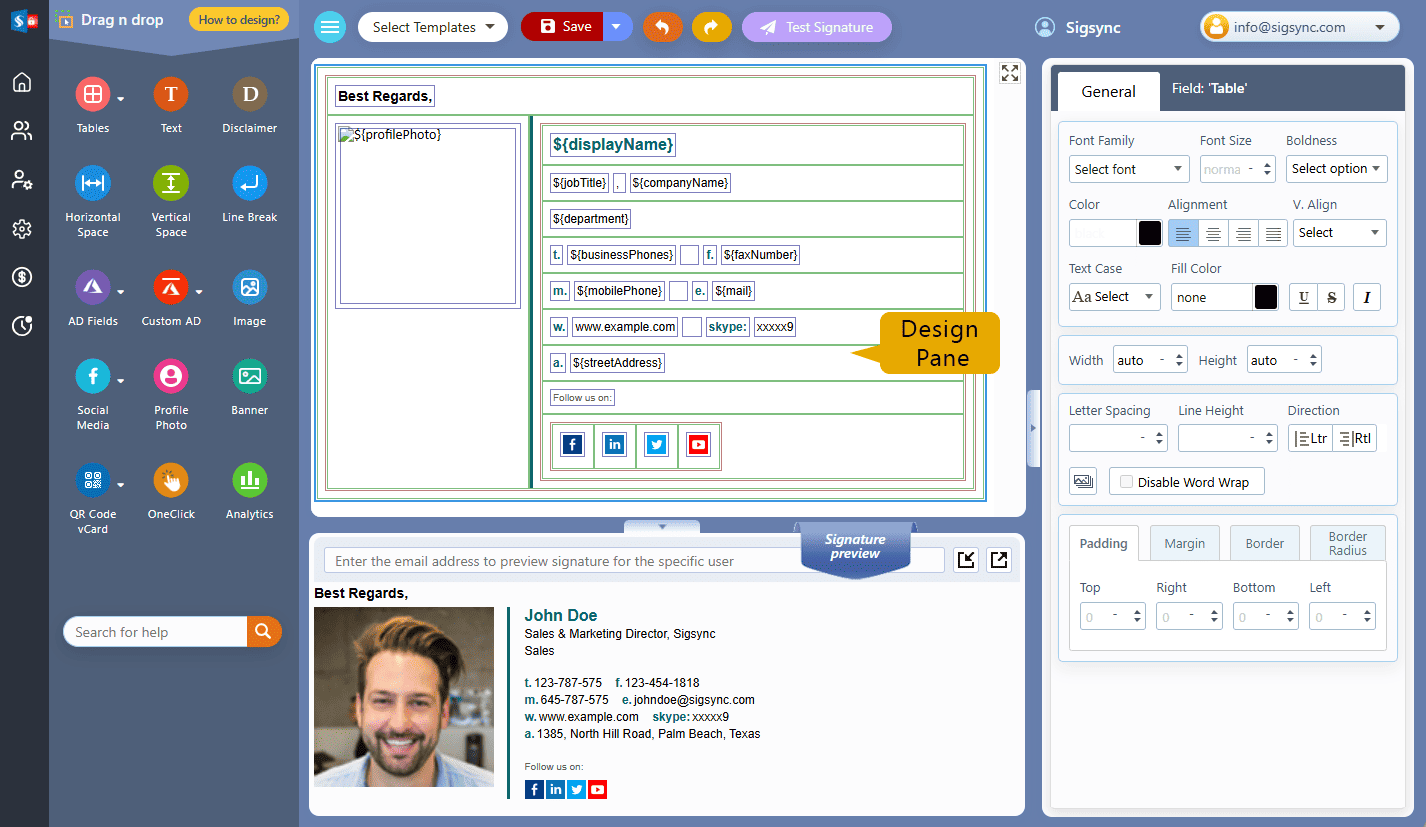
The Design Pane in the Sigsync Editor serves as a canvas for creating and customizing email signatures. Users can insert components such as images, logos, social media icons, personal and contact information, and text onto the design pane. Once added, these elements can be arranged, resized, and formatted to achieve the desired layout and appearance for a professional signature.
- Properties Pane:
The Properties Pane in the Sigsync Editor allows users to customize and fine-tune each component added to the Design Pane. You can adjust settings such as font style, size, color, alignment, padding, margins, and borders. This pane provides full control over the appearance and formatting of each element, ensuring a professional and consistent email signature.
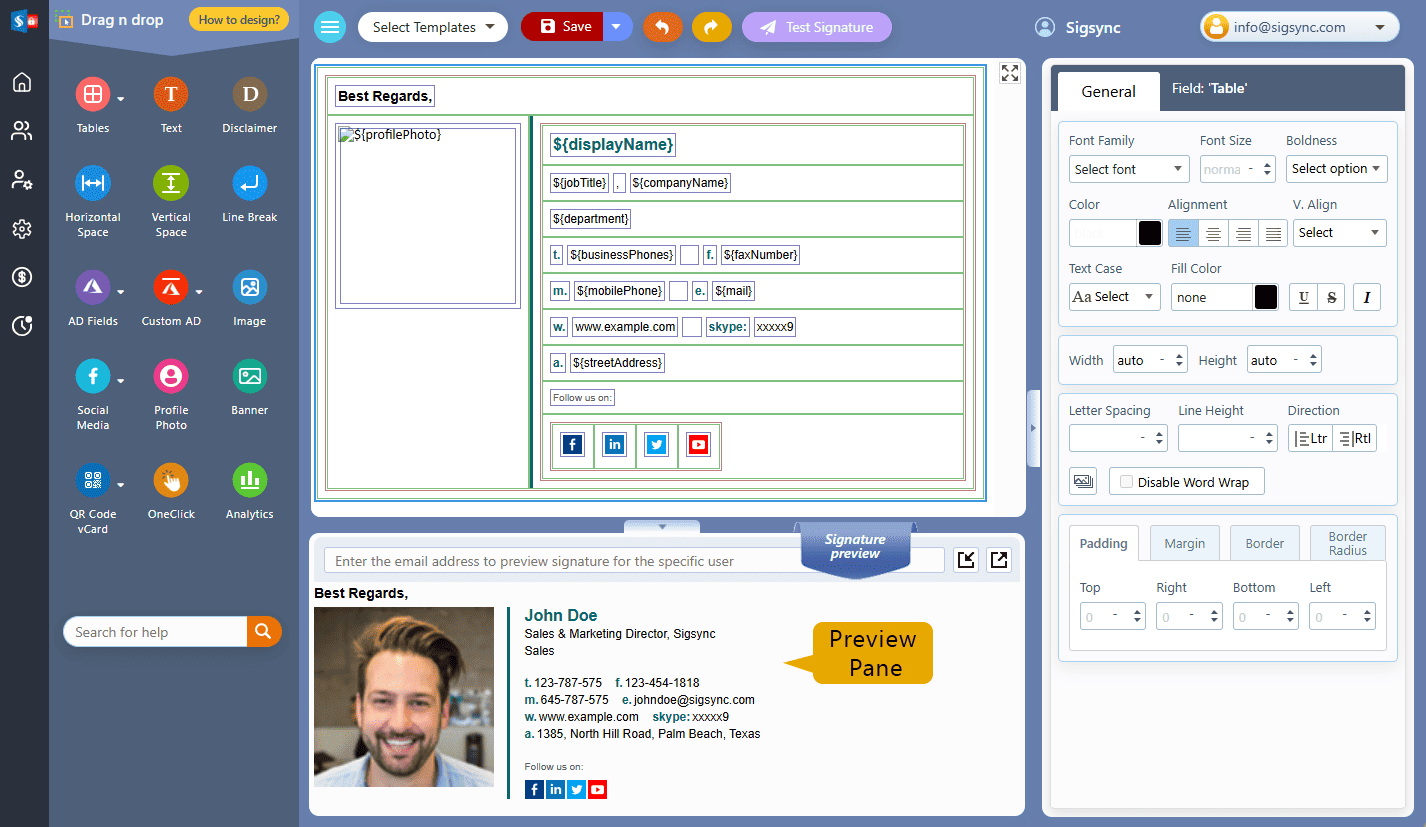
The Properties pane provides a comprehensive range of options for customizing signature components, including the following properties:
- Fonts, Color: You can customize the font style and color of your email signature.
- Alignment, Text Decoration: You can align the text and add formatting like bold, italic, and underline.
- Height, Width, Padding: You can adjust the height, width, and padding of your signature to make it look visually appealing.
- Border (line separator): You can add a line separator to create a visual separation between different parts of your signature.
- Background Image: You can add a background image to your signature for a more personalized touch.
- Edit Dynamic (Azure AD) fields: You can modify dynamic fields from Azure AD to reflect your latest information.
- Hyperlink: You can add hyperlinks to your signature to direct recipients to your website or social media pages.
- Row & Column - Split, Merge, Insert, Delete: You can modify the layout of your signature by splitting, merging, inserting, or deleting rows and columns.
- Display / Hide Signature fields: It prevents empty fields in your signature when the corresponding Active Directory value is not available by allowing you to choose which signature fields to display or hide.
- Remove / Add Newline (line break): You can add or remove newlines to control the spacing between different parts of your signature.
- Preview Pane:
The Preview Pane in the Sigsync Editor allows users to view a real-time preview of their email signature as changes are made. This feature helps visualize how the signature will appear to recipients, making it easier to refine the layout, formatting, and overall design for a professional and accurate final result.
- Editor Toolbar:
The Sigsync Editor includes a comprehensive toolbar that simplifies the signature design process, giving users quick access to essential tools to manage templates efficiently.
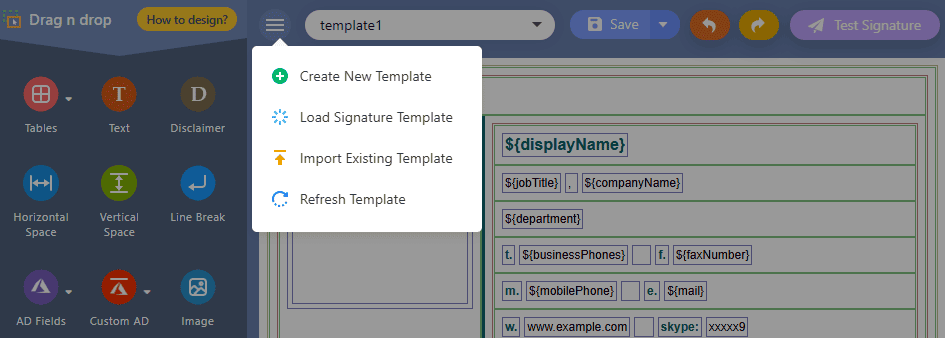
- Create New Template: This option allows you to create a new email signature template from scratch. Alternatively, you can choose a pre-designed template and customize it, or request a free custom signature design to meet your company’s needs.
- Load Signature Template: Use this option to load an existing email signature template from your Sigsync gallery, allowing you to edit or update it as needed. This makes it easy to reuse templates and maintain consistent email signatures across your organization.
- Import Existing Template: This option lets you import email signature templates from other sources, such as HTML files. It provides a quick way to continue using your existing designs without starting from scratch.
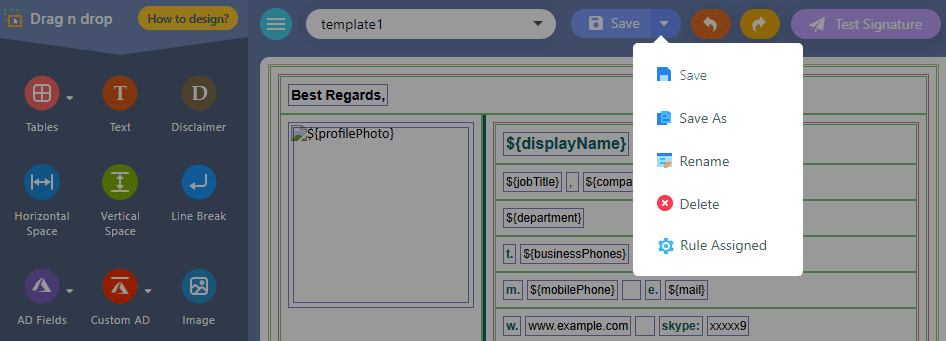
- Save Template: After creating or updating an email signature template, you can use this option to save it to your Sigsync account for future use.
- Save As Template: This option allows you to create a duplicate of an existing email signature template. You can then modify the copied version to create a new template without affecting the original.
- Rename Template: If you want to change the name of an email signature template, use this option to update it to a more descriptive or meaningful name.
- Delete Template: This option allows you to delete an existing email signature template that you no longer need or want to use.
- Refresh Template: Use this option to refresh the page and update the list of email signature templates in your Sigsync account.
- Rule Assigned: This option provides detailed information about the rules that have been assigned to specific email signature templates, helping you to manage and organize your email signatures more effectively.
- Test Signature: With the signature tester, you can get a sneak peek of how your email signature will look before sending it out to your recipients. It allows you to preview the signature that will be automatically applied based on the conditions set in the signature rule.
Next Navigate To:
In this manual